What Happens Inside Your Body During a Tattoo Session?
By InkingKings Tattoo Studio
Let Us Color Your Story
A tattoo session is often seen as a simple process: needle, ink, skin, design. But biologically, it is one of the most complex experiences the human body can go through while being fully conscious.
Tattooing is not just a surface-level event. It activates multiple internal systems at the same time — neurological, immune, circulatory, metabolic, and psychological.
From the very first needle contact to the moment the session ends, your body enters a highly organized internal process that involves protection, adaptation, healing, and memory formation.
This is the complete internal journey of what actually happens inside your body during a tattoo session.
The First Needle Contact: The Signal Phase
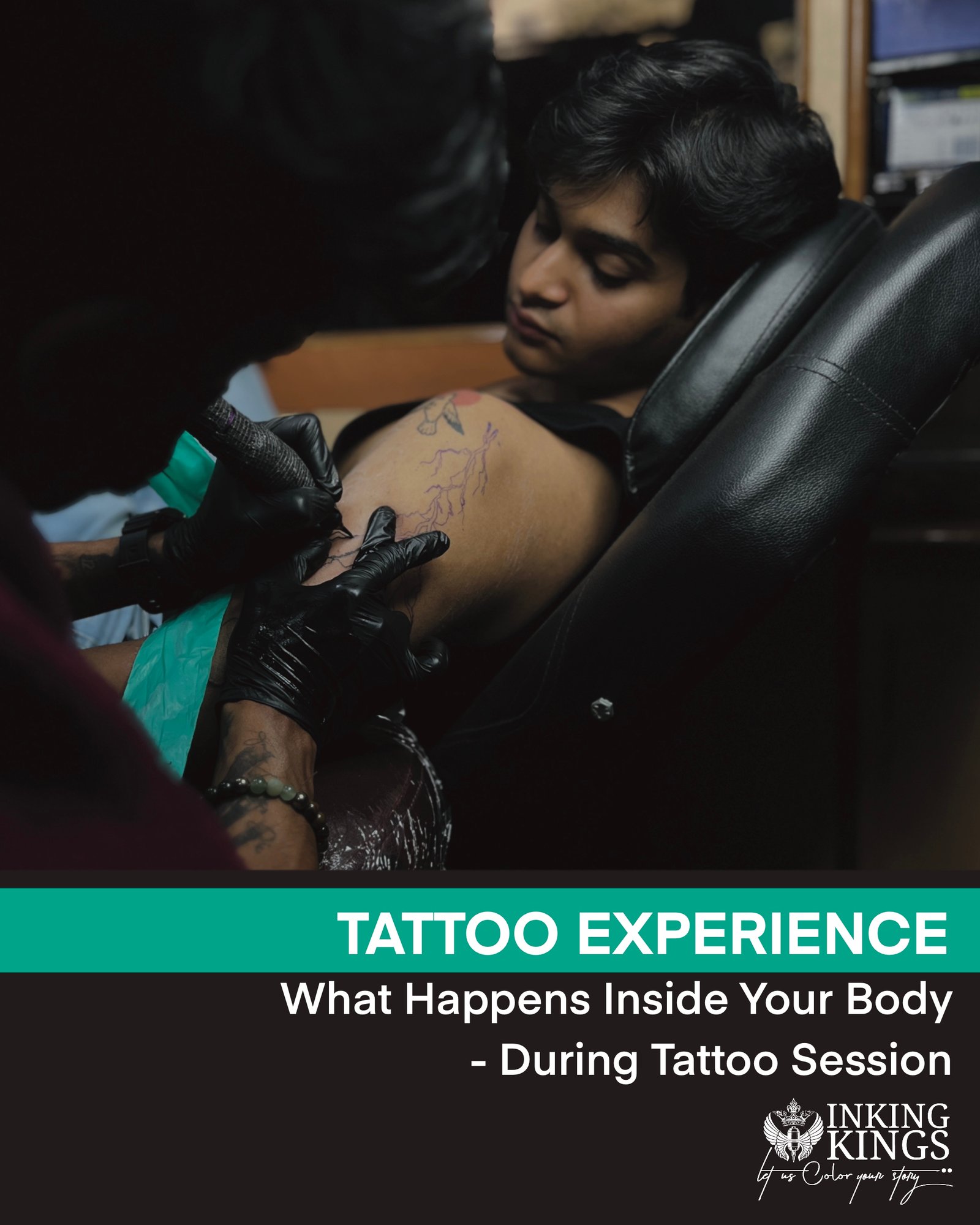
The moment the needle touches your skin, the first thing that happens is not pain — it is signal transmission.
Your nerve endings instantly send electrical signals to the brain. These signals travel faster than conscious thought.
Before your mind reacts emotionally, your nervous system has already activated your body’s defense and regulation systems.
At this stage:
- Pain receptors activate
- The nervous system enters alert mode
- The brain interprets the sensation as controlled trauma
Your body shifts from normal resting state into response mode.
Chemical Reaction in the Brain
Within seconds, your brain releases:
- Adrenaline – increases alertness and focus
- Endorphins – natural painkillers
- Dopamine – helps regulate stress response
This chemical release is why many people experience:
- Sharpened focus
- Calmness after initial discomfort
- Reduced panic
- Mental clarity during sessions
Your body doesn’t collapse under stress — it chemically reorganizes itself to handle it.
Nervous System Regulation
After the initial shock, your nervous system begins regulating the experience instead of reacting to it.
Pain becomes predictable.
Signals become organized.
Your body adapts to the sensation.
This is why:
- The first minutes feel intense
- The middle of the session feels more stable
- The body starts syncing with the process
Your nervous system is not fighting the tattoo — it is managing it.
Immune System Activation: Why Tattoos Become Permanent
Your immune system identifies tattoo ink as a foreign substance.
White blood cells (macrophages) rush to the tattooed area. Instead of removing the ink completely, they trap pigment particles in the dermis layer of the skin.
This creates biological storage.
This is the real reason tattoos become permanent:
- The immune system isolates the ink
- Cells hold the pigment
- The body protects it inside tissue structures
Your body doesn’t reject the ink — it contains and preserves it.
Skin Trauma and Repair at the Same Time
Tattooing creates thousands of microscopic punctures in the skin.
But the body doesn’t wait for the tattoo to finish to start healing.
Healing begins immediately.
Processes happening simultaneously:
- Skin cells start regenerating
- Collagen production activates
- Tissue repair begins
- New cellular structures start forming
Your skin is being opened and rebuilt at the same time.
Blood Flow and Inflammation Response
Blood vessels in the tattooed area expand.
This increases:
- Oxygen delivery
- Nutrient transport
- Immune cell movement
- Healing agent circulation
Inflammation starts — but inflammation is not damage. It is a healing signal.
Redness, warmth, and swelling are signs of your body entering repair mode.
Energy Consumption and Physical Fatigue
Tattoo sessions are metabolically demanding.
Your body is managing:
- Pain regulation
- Stress response
- Immune activity
- Cellular repair
- Blood circulation
- Brain chemistry
All of this requires energy.
Your body uses:
- Glucose
- Oxygen
- Stored energy reserves
This is why people often feel tired, drained, or heavy after long tattoo sessions.
Fatigue is not weakness — it is biological workload.
Psychological Processing
The brain also processes the tattoo emotionally.
It links:
- Sensation
- Memory
- Meaning
- Identity
- Experience
This is why tattoos are often deeply personal.
The body doesn’t just store ink — it stores experience.
When the Session Ends
When the needle stops, the process does not.
Inside your body:
- Skin repair continues
- Immune response remains active
- Inflammation slowly reduces
- Ink stabilization continues
- Tissue reconstruction begins
- Healing systems stay active
The tattoo session ends.
The biological process continues for days and weeks.
The Reality of Tattooing
A tattoo is not something done only to your skin.
It is something your entire body participates in.
From brain chemistry to immune memory, from nerve signaling to cellular repair, tattooing is a full-body biological process.
The needle starts it.
Your body completes it.
Final Thought
A tattoo is not just art placed on the body.
It is:
- Adaptation
- Healing
- Memory
- Biology
- Permanence
Working together.
This is why tattoos last.
Not because of ink.
But because your body chooses to keep them.
InkingKings Tattoo Studio
Where art meets biology, identity, and permanence.
Let Us Color Your Story